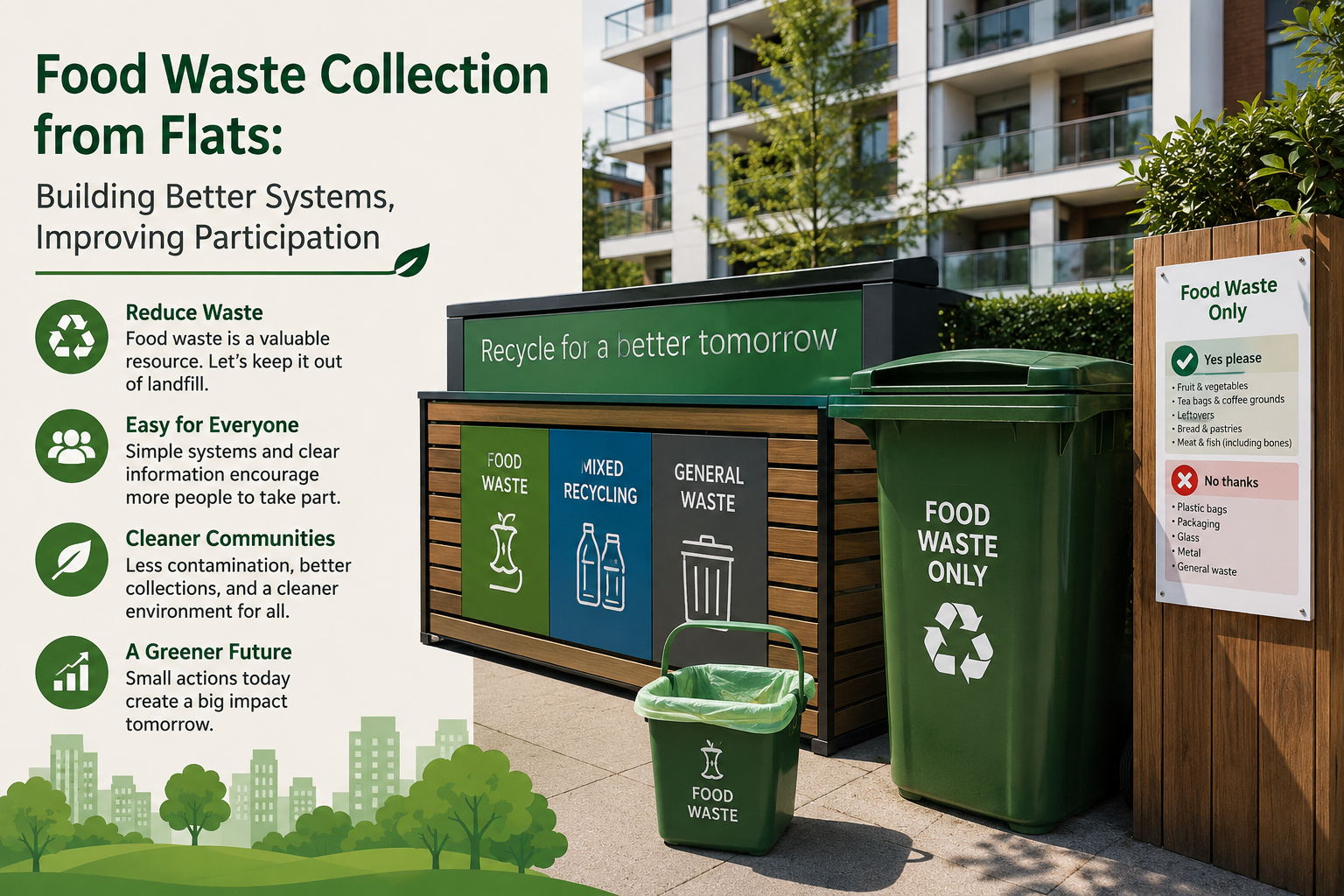
From April 2026, under the Simpler Recycling reforms in England, many local authorities and waste collection providers will be required to introduce separate food waste collections for households that do not already have them. While collecting food waste from individual houses is generally straightforward, flats and high-density residential developments present a much greater challenge.
As more councils expand separate food waste services, ensuring that collection systems are practical, hygienic and easy for residents to use will be critical to achieving high participation rates and reducing contamination.
Why Food Waste Collection Matters
Food waste is one of the largest components of household residual waste. When sent to landfill or energy recovery unnecessarily, valuable organic material is lost that could instead be treated through anaerobic digestion or composting to generate renewable energy and soil improvers.
Effective food waste collection can help:
- Reduce residual waste volumes
- Increase recycling performance
- Lower greenhouse gas emissions
- Support the circular economy
- Improve compliance with national recycling legislation
However, these benefits can only be achieved if residents actively participate in the collection scheme.
The Challenge of Flats and Apartments
Unlike individual houses, apartments often share communal waste facilities, creating additional operational challenges.
Common issues include:
- Limited space for additional food waste bins
- Increased contamination from mixed waste
- Odour and pest concerns
- Accessibility for residents
- Difficulties servicing communal bin stores
- Higher management requirements
For housing providers, local authorities and waste contractors, designing a collection system that residents will actually use is just as important as the collection itself.
Resident Behaviour is Key
One of the biggest lessons emerging across the sector is that infrastructure alone does not guarantee success.
Residents are more likely to participate when the system is:
- Simple to understand
- Convenient to access
- Well communicated
- Consistently serviced
- Clean and well maintained
Small barriers—such as long walking distances to communal bins or uncertainty about what can be recycled—can significantly reduce participation.
Clear communication remains one of the most effective ways of improving recycling performance.
Designing an Effective Food Waste Collection System
Every development is different, but successful schemes often consider:
Convenient Kitchen Storage
Residents benefit from having a small kitchen caddy that makes separating food waste quick and easy before taking it to communal collection points.
Well-Located External Bins
Communal food waste containers should be:
- Easy to access
- Clearly labelled
- Well maintained
- Located alongside other recycling facilities where possible
Clear Signage
Simple visual guidance helps residents understand:
- What can be placed in food waste bins
- What should be excluded
- How to use compostable liners where appropriate
Managing Contamination
Contamination remains one of the biggest risks to food waste recycling.
Common contaminants include:
- Plastic bags
- Packaging
- General household waste
- Glass
- Metal
- Disposable nappies
Reducing contamination requires a combination of good communication, suitable bin design and regular monitoring.
The Importance of Data
As food waste collections become more widespread, data will play an increasingly important role in service improvement.
Monitoring information such as:
- Participation rates
- Collection frequencies
- Contamination levels
- Missed collections
- Overflow incidents
can help identify where operational improvements or resident engagement may be needed.
Using data to review collection performance enables organisations to make informed decisions rather than relying solely on assumptions.
Designing Services Around People
Successful waste collection systems are ultimately designed around the people using them.
Understanding how residents interact with communal waste facilities can help improve:
- Accessibility
- Convenience
- Participation
- Service efficiency
- Overall recycling performance
Small changes to bin placement, signage or communication can often have a greater impact than expensive infrastructure upgrades.
Looking Ahead
As separate food waste collections continue to expand across England, organisations responsible for residential waste services will need to balance legislative compliance with practical service delivery.
Well-designed collection systems can improve recycling rates, reduce contamination and encourage long-term behavioural change, particularly within high-density housing developments where waste management is often most challenging.
By combining good planning, resident engagement and ongoing performance monitoring, councils, housing providers and waste contractors can create food waste collection services that are both efficient and sustainable.
How WPS Can Help
At WPS, we support organisations across the waste and environmental sector with practical compliance and waste management solutions. Whether reviewing waste storage arrangements, developing waste strategies or supporting environmental compliance, our focus is on delivering systems that are effective, practical and aligned with current legislation.
As food waste collections continue to evolve, taking a proactive approach today can help organisations prepare for tomorrow’s regulatory requirements.