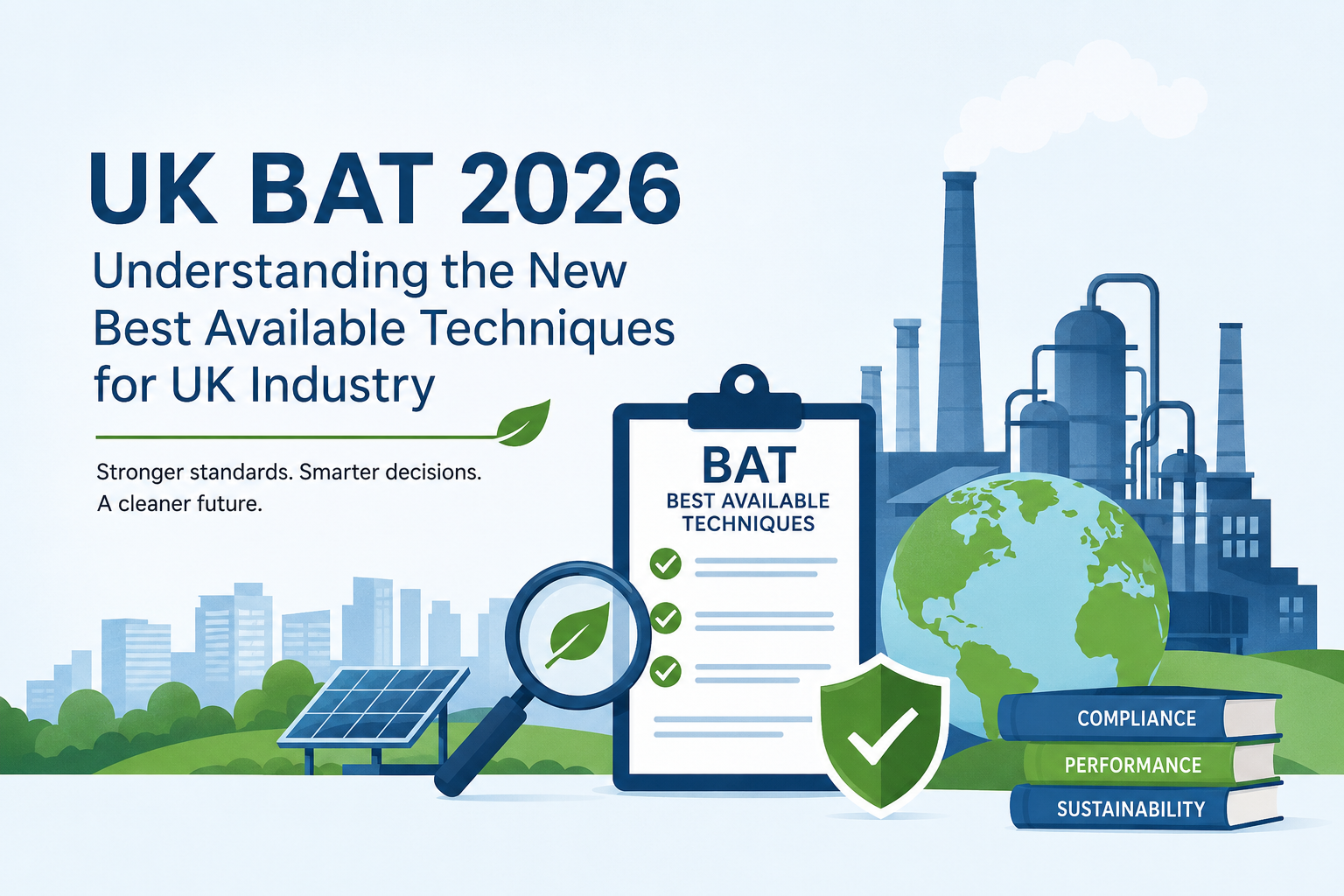
The UK environmental permitting landscape is entering one of its biggest changes since Brexit. Following the publication of the UK’s first independent Best Available Techniques (UK BAT) conclusions for the chemical sector, operators regulated under the Environmental Permitting Regulations will need to understand how these new requirements affect compliance, emissions, monitoring and future investment.
At a recent webinar hosted by the Chemical Industries Association (CIA), industry experts discussed the development of UK BAT, implementation timelines, derogation procedures, environmental assessment methods and the future direction of BAT guidance. Here are the key takeaways.
What is UK BAT?
Best Available Techniques (BAT) are the technologies, operating methods and management practices considered the most effective way of preventing or reducing pollution while remaining technically and economically viable.
Following the UK’s departure from the European Union, the Environment Agency, Scottish Environment Protection Agency (SEPA), Natural Resources Wales and the Northern Ireland Environment Agency have developed a UK-specific BAT framework.
The first UK BAT conclusions apply to Large Volume Organic Chemicals (LVOC) and represent the beginning of a wider programme replacing EU BAT Conclusions over the coming years.
Why has UK BAT been introduced?
Previously, UK regulated installations relied upon EU BAT Conclusions (BATCs).
The UK framework allows regulators to:
- Produce guidance specific to UK industry
- Reflect UK environmental priorities
- Update requirements independently of the EU
- Maintain high environmental standards whilst recognising UK operational conditions
Although based heavily on the EU BAT Reference Documents (BREFs), UK BAT introduces additional UK guidance and flexibility.
Which industries are affected?
The current UK BAT applies primarily to Schedule 1 chemical installations, particularly those regulated under the Industrial Emissions framework.
Future UK BAT documents are expected across multiple sectors including:
- Chemicals
- Waste treatment
- Energy
- Metals
- Food and drink
- Surface treatment
- Refineries
- Other industrial sectors currently regulated under BAT
The UK BAT Timeline
The webinar highlighted the implementation programme:
- Publication of UK BAT Conclusions
- Operators review compliance
- Permit variation process
- Gap assessments
- Improvement programmes
- Implementation within regulator timescales
Operators should begin assessing compliance now rather than waiting for permit variations.
Three Types of BAT Requirements
One of the biggest changes discussed was that UK BAT now contains three complementary elements.
Technical BAT
Physical equipment and engineering controls, including:
- Abatement systems
- Process optimisation
- Monitoring equipment
- Emission control technologies
Narrative BAT
Operational and management requirements covering:
- Environmental management systems
- Maintenance
- Operator competence
- Operational procedures
- Inspection programmes
- Monitoring strategies
These often require procedural improvements rather than new equipment.
Associated Emission Levels (AELs)
AELs define the expected emission performance when BAT is applied.
These become important during permit reviews and compliance assessments.
Understanding BAT-AELs
A significant part of the webinar focused on BAT Associated Emission Levels.
Regulators expect installations to operate within these ranges under normal operating conditions.
If operators cannot achieve the published BAT-AELs, they must either:
- Improve performance, or
- Demonstrate why a derogation should be granted.
When can a Derogation be Granted?
Article 15(4) of the Industrial Emissions Directive (retained within UK legislation) allows derogations in exceptional circumstances.
A successful derogation must demonstrate that achieving BAT would lead to disproportionately higher costs compared with the environmental benefits.
Evidence may include:
- Site-specific technical constraints
- Plant design limitations
- Local environmental conditions
- Cost-benefit analysis
- Environmental impact assessments
Importantly, derogations are not automatic and require robust technical justification.
The New Impact Pathway Approach
One of the most interesting topics covered was the UK’s move towards an Impact Pathway Approach.
Rather than simply comparing emissions against numerical limits, regulators increasingly consider:
- Air quality impacts
- Human health
- Ecological receptors
- Local environmental sensitivity
- Dispersion modelling
- Existing background pollution
This enables more proportionate, evidence-based permitting decisions. Air Quality Assessments are Becoming More Important
Operators may increasingly require:
- Dispersion modelling
- Air quality assessments
- Environmental risk assessments
- Site-specific receptor analysis
These assessments help determine whether emissions genuinely present unacceptable environmental impacts.
Damage Costs
The webinar also discussed the use of damage costs.
Damage costs place a monetary value on environmental impacts from pollutants such as:
- Nitrogen oxides (NOx)
- Sulphur dioxide
- Particulates
- Other key emissions
These values help regulators compare:
- Environmental benefits
- Cost of BAT implementation
- Whether derogation arguments are justified
Monitoring Requirements are Increasing
Several BAT conclusions place greater emphasis on monitoring.
Examples include:
- Continuous emissions monitoring
- Leak Detection and Repair (LDAR)
- Process monitoring
- Wastewater monitoring
- Energy efficiency monitoring
- Performance verification
Operators should ensure monitoring systems remain fit for purpose.
Published Regulator Guidance
The regulators have already published supporting guidance covering:
- Applying BAT
- BAT derogations
- BAT-AEL assessments
- Schedule 20 emissions activities
- Cost-benefit analysis
- Environmental appraisal methods
These documents provide important context beyond the BAT conclusions themselves.
What About Europe?
Although the UK now has its own BAT framework, developments within Europe remain highly relevant.
The webinar highlighted ongoing work to revise EU BREFs, including proposals to:
- Streamline future BREF updates
- Improve consistency between sectors
- Increase digitalisation
- Strengthen environmental performance requirements
- Improve review processes
Many future UK BAT documents are still expected to draw heavily from these evolving European BREFs.
What Should Operators Do Now?
If your installation falls within the scope of UK BAT, now is the time to prepare.
Recommended actions include:
- Review the relevant UK BAT Conclusions.
- Carry out a BAT gap analysis.
- Compare current emissions with BAT-AELs.
- Review monitoring programmes and environmental management systems.
- Identify any improvement projects required.
- Consider whether a derogation assessment may be necessary.
- Engage early with regulators during permit variation discussions.
Early preparation will help avoid delays, unexpected compliance costs and regulatory challenges.
How WPS Can Help
Navigating the UK’s evolving BAT framework can be challenging, particularly where permit variations, air quality assessments or derogation cases are involved.
WPS supports organisations with:
- UK BAT compliance reviews
- BAT gap assessments
- Environmental permit support
- Air quality and environmental impact assessments
- BAT derogation strategies
- Environmental management systems
- Ongoing regulatory compliance support
As UK BAT continues to expand across industrial sectors, businesses that plan early will be best placed to remain compliant while making informed, cost-effective investment decisions.